
A strong third-quarter (October-December/Q3) performance for 2025-26 (FY26) has helped the stock of India's largest listed pharmaceutical (pharma) company, Sun Pharmaceutical Industries, gain about 7 per cent since the start of February.
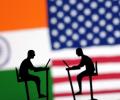
The US is expected to push for sweeping changes in India's policies, ranging from tariff reductions to regulatory overhauls, that could benefit American firms and exporters, under the proposed bilateral trade agreement with India, think tank GTRI said on Sunday.

The rupee plunged 38 paise to close at an all-time low of 90.32 against the US dollar on Thursday amid uncertainty over the India-US trade deal. Forex traders said the rupee is expected to trade with a negative bias as the delay in the trade deal between India and the US may continue to dent investor confidence.

Delhi Police arrested four Indian Youth Congress workers for staging a shirtless protest at the AI Impact Summit venue, with officials investigating a potential wider conspiracy.

The Delhi Police arrested four IYC workers and booked them at Tilak Marg Police Station under multiple provisions, including criminal conspiracy, unlawful assembly, assault on public servants, obstruction of duty, and disobedience to orders promulgated by public authorities.
Chief negotiators from India and the US are set to begin three-day talks in Washington to recalibrate the bilateral trade agreement (BTA) framework, following significant changes in the US tariff landscape, including a new 10 per cent tariff imposed on all countries.

Rahul Gandhi said that had an INDIA Bloc government negotiated the trade agreement with the US, it would have told US President Donald Trump that he should treat India as an equal.

Benchmark equity indices Sensex and Nifty extended their gains for the second straight session on Monday, driven by optimism over the India-US trade deal and robust buying in public sector banks, consumer durables, and realty stocks.

From the Sensex firms, Mahindra & Mahindra, Maruti, Adani Ports, Bajaj Finserv, Titan, and HDFC Bank were among the major laggards. However, Hindustan Unilever, Trent, HCL Tech, Asian Paints, and Tata Steel were among the gainers.

The rupee declined 31 paise to settle at 90.65 against the US dollar on Friday, weighed down by geopolitical uncertainties over the US-Iran talks, and a sharp rise in global crude oil prices.

The first leg of the Budget session concluded with debates over the India-US trade deal and a former army chief's memoir, and will reassemble on March 9.

India is seeking either an exemption or a longer timeline on the pharmaceutical tariffs, expected to kick in by July 31.

'When negotiators meet next, they may like to bring new issues to the table.'

India's merchandise exports experienced a slight decrease in February, while imports surged due to increased gold and silver purchases, leading to a widened trade deficit. The West Asia crisis is expected to further impact trade in the coming months.

India and the US are expected to sign the first phase of a bilateral trade agreement by mid-March, which will result in the US lowering import duties on Indian goods. India will then begin reducing import duties on certain US goods.
India and the US are expected to sign the first phase of a bilateral trade agreement by mid-March, which will result in the US lowering import duties on Indian goods. India will then begin reducing import duties on certain US goods.

The finance minister said that consolidation of state-owned banks could proceed at any time without waiting for the recommendations of the proposed high-level committee on banking.

India has clarified its position on the proposed interim trade agreement with the US, stating that the joint statement remains the basis for mutual understanding. Amendments to a White House fact sheet reflect shared understandings, with both sides working towards finalizing the agreement.

Stock market benchmark indices Sensex and Nifty ended 2.5 per cent higher on Tuesday after India and the US agreed to a trade deal under which Washington will bring down the reciprocal tariff on Indian goods to 18 per cent.

US Secretary of State Marco Rubio will visit India for four days to strengthen bilateral relations, holding talks with Indian leaders and attending the Quad foreign ministers' meeting.

External Affairs Minister S Jaishankar and US Secretary of State Marco Rubio discussed cooperation in trade, critical minerals, nuclear energy, and defence, reaffirming commitment to a free and open Indo-Pacific.

India has agreed to allow import of pork and pork products from the US as a part of a bilateral trade deal which will facilitate export of Indian mangoes and pomegranate to the US. The development comes months after the two governments renewed the India US Trade Policy Forum (TPF), after which both nations agreed to iron out thorny issues that included market access issues pertaining to the agriculture sector.

The rupee, which was the worst performing Asian currency in 2025 and also in January, was the best performing Asian currency on Tuesday.

'Incidentally, Prime Minister (Modi) and President Trump have also spoken on the phone on eight occasions during 2025, covering different aspects of our wide-ranging partnership'
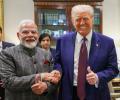
The agreement addresses non-tariff barriers and promotes increased trade in technology products and cooperation between the two countries.

The Indian rupee, swaying through multiple headwinds, tiding over global trade disruptions and massive foreign fund outlfows, is unlikely to arrest its descent until tariff impact overhangs, notwithstanding robust domestic macroeconomic tailwinds. The Reserve Bank of India (RBI), which sees the rupee's depreciation as a silver bullet to offset the tariff shock, expects the currency to find its stable course once India reaches a trade deal with its largest trading partner, the US.

Prime Minister Narendra Modi stayed calm, avoided public confrontation, and focused on India's long-term interests to steady ties with the United States.
Benchmark equity indices Sensex and Nifty rebounded on Thursday after three sessions of losses, tracking gains in global markets after US President Donald Trump struck a conciliatory tone on Greenland. In a volatile session, the 30-share BSE Sensex climbed 397.74 points, or 0.49 per cent, to close at 82,307.37.

Congress leader Rahul Gandhi criticised the BJP and RSS for undermining the Constitution and accused the TMC of failing to provide jobs in West Bengal during recent rallies.

With the India-US trade talks moving in the right direction, Commerce and Industry Minister Piyush Goyal is expected to visit Washington soon, sources said.

Following a Supreme Court setback, Donald Trump has announced an increase in global tariffs from 10% to 15%, impacting international trade relations and raising concerns about economic repercussions.
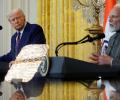
India and the US have entered a new phase in their relationship, marked by greater parity, point out Harsh V Pant and Vivek Mishra.

'The flip side of this is that he won't hesitate to call out India if he thinks its policies are hurting US economic interests or border US foreign policy goals.'

A Delhi court has criticized the conduct of Indian Youth Congress workers who protested at the AI Impact Summit venue, stating their actions were not legitimate dissent but a 'blatant assault on public order' that also harmed the country's diplomatic image.
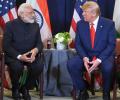
President Trump, forcefully pursuing his 'America first" policy, has previously described India as a "tariff king" for imposing "tremendously high" tariffs on American products, also expressed dissatisfaction over the US-India trade ties. "Well, we can have a trade deal with India, but I'm really saving the big deal for later on," Trump, who is scheduled to visit India on February 24 and 25, told reporters at the Joint Base Andrews outside Washington on Tuesday when asked whether he expects a trade deal with India before the visit.

External Affairs Minister S Jaishankar raised India's concerns with US Secretary of State Marco Rubio regarding changes to US visa and immigration policies, emphasising that legal mobility should not be negatively affected. Rubio acknowledged potential 'bumps' during the transition as the US aims to improve its immigration system.

Prime Minister Narendra Modi and US Secretary of State Marco Rubio discussed various aspects of India-US bilateral ties, focusing on defence, trade, energy, and technology. Rubio extended an invitation from President Donald Trump for PM Modi to visit the US.

India and Canada are negotiating a long-term uranium supply agreement worth $2.8 billion. They are also exploring expanded civil nuclear cooperation after the passage of the SHANTI Bill.

Despite decades of efforts towards energy transition, oil will remain the critical energy source for all nations for some decades. We can hope for peace opening the Strait of Hormuz, but must prepare for war closing it, points out former foreign secretary Ranjan Mathai.

Economic Advisory Council to the Prime Minister (EAC-PM) member Sanjeev Sanyal on Thursday said he is not concerned about the rupee at all, arguing that even China and Japan witnessed exchange rate weaknesses during their high growth phases.
